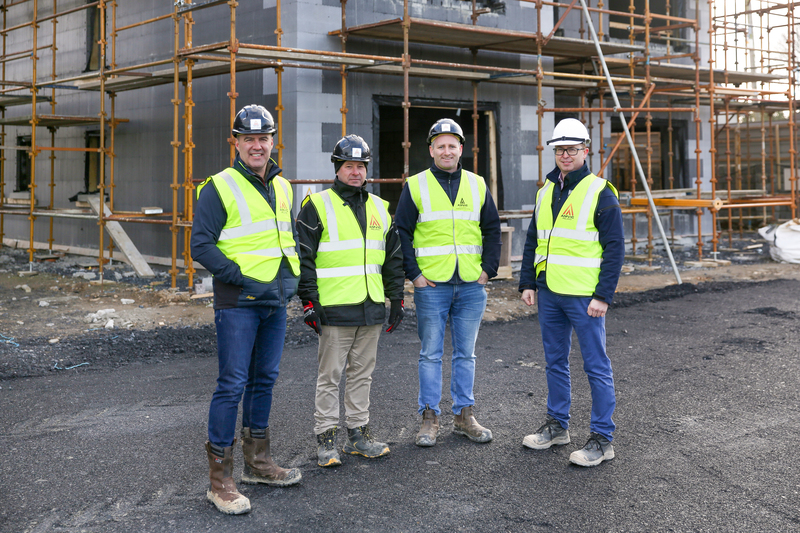
Long-term structural integrity and compliance depend on the consistency with which it is manufactured and installed. Recognising this, Amvic has developed a comprehensive quality control framework that governs every stage of Insulated Concrete Formwork (ICF) delivery. From the exclusive use of approved installers to adherence with structural design protocols, all conducted in full accordance with EN 1992-1-1 and other relevant guidelines and standards, each step upholds uniformity, reduces variability, and extends the finished structure’s operational lifespan.
Maintaining Quality from Manufacture to Certification
Amvic’s ICF system is subject to strict manufacturing oversight from the outset, with every block produced to precise tolerances that ensure consistency and regulatory compliance. This level of precision ensures that every interlocking expanded polystyrene (EPS) unit contributes to a structurally uniform wall assembly that fully adheres to benchmarks for compressive strength, thermal conductivity, dimensional stability, and durability per EN 13163:2012+A2:2016.
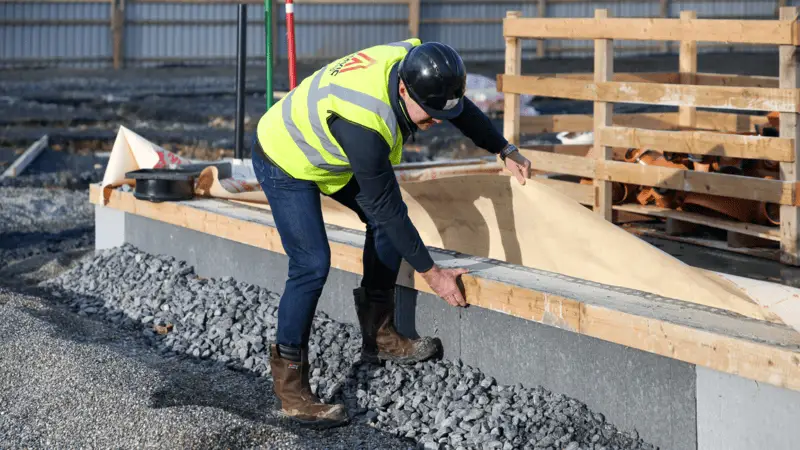
That same commitment to quality continues from the factory floor to the construction site, where strict assurance processes ensure level foundations, precise layouts, and correct block alignment, each essential to maintaining structural alignment and preserving bond integrity as the build progresses. Once the formwork is in place, reinforcement is then positioned according to strict engineering specifications, with adequate cover and continuity to ensure the concrete core functions as a unified structural element. During pouring, critical checks are conducted for correct mix ratios, namely thorough compaction and proper curing, both essential to preventing voids and achieving the integrity that defines effective ICF construction.
This comprehensive approach to quality has been independently validated and certified by both the National Standards Authority of Ireland Agrément Board (NSAI IAB) and the British Board of Agrément (BBA). These accreditations confirm that Amvic ICF is demonstrably capable of withstanding wind pressure, seismic activity, and structural loads typical of design expectations associated with mid-rise applications. Importantly, this certification accounts for the entire construction process-from materials and manufacturing standards to installation protocol-offering specifiers, engineers, and developers full confidence that Amvic’s ICF systems can withstand real-world challenges.
This approach mitigates early-stage errors, helping protect schedules while delivering safer, more durable outcomes through clearly defined procedures. This strengthens structural reliability during both construction and occupancy. Further complementing this is the use of extra high-density expanded polystyrene (EPS) and reinforced concrete, both of which contribute to structural longevity and lower energy use courtesy of minimised thermal bridging. Collectively, this all adds up to improved support of long-term sustainability objectives through improved U-values and, with that, reduced environmental impact.
Quality Built into Every Stage of the Process
With quality embedded into each phase of production and delivery, Amvic ICF offers a construction system shaped by process integrity and technical rigour. From precision-controlled manufacturing environments to certified installation carried out by approved teams, every element is defined by adherence to recognised standards, ensuring that each structure benefits from consistent performance characteristics. This reduces the need for reactive intervention and supports more predictable project outcomes. As developers and specifiers seek methods that align with performance, compliance, and long-term value, Amvic ICF stands out as a solution in which quality is consistently sustained.